Intelligent activation for healthier lives.
By harnessing the potential of AI, we aim to maximise efficiency and increase service capacity to provide a platform to manage higher volumes of empowered patients without compromising on care quality.
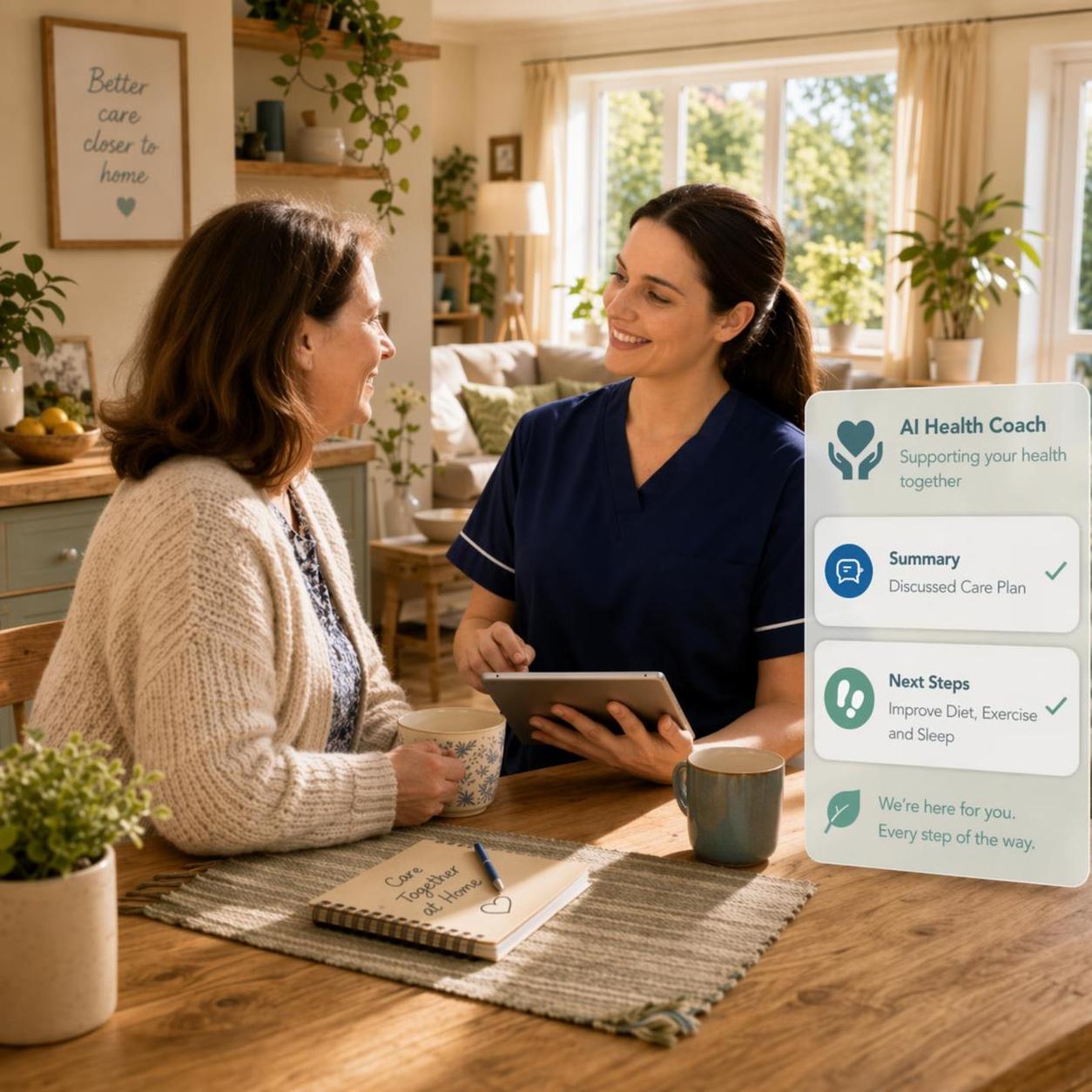
We have developed an AI-powered patient activation and coaching platform and system that delivers personalised, proactive support to patients at the point of greatest impact — in their home, in their community, and between clinical contacts.
We leverage agentic AI to do what the healthcare system currently cannot: maintain a continuous, intelligent relationship with patients between appointments — coaching, prompting, and activating them to manage their conditions more effectively and confidently.
Our platform shifts care from a reactive, episodic model to a proactive, continuous one — unlocking the most underutilised asset in healthcare: the patient and their support network.
Most importantly, the AI works with health and care staff. The AI is delivering the care plan agreed between the patient and clinical and care staff, and the AI has an escalation path back to a human — thus its 'AI in the loop'.
A personalised AI assistant for patient activation and guidance.
ActiViseHealth helps patients become active participants in their care. It turns provider-approved pathways into personalised, trackable, AI-supported care plans that patients can understand and follow, with an AI assistant that keeps adapting the support to the patient rather than expecting every patient to fit the same pathway.
For planned operations
Procedure information, pre-habilitation, pre-operative readiness, day-of-surgery preparation, post-discharge monitoring, rehabilitation and review.
For long-term conditions
Education, lifestyle change, self-monitoring, connecting with local services, behavioural nudges and escalation for support when risks increase.
Our Solution
Covers enrolment to achieving the patient and clinical goals. ActiViseHealth supports the patient and clinical team by:
An activation layer
Measure knowledge, confidence, self-management skills and engagement to tailor the level of support.
A digital coach
Encourage progress, ask what is getting in the way, and personalise the next prompt for every patient.
A digital assistant
Explain the plan, answer questions, collect patient-reported information and surface what clinicians need to see.
A digital coordinator
Connect patients with local services, navigate the next step, and keep care continuous between appointments.
A review and safety loop
Always escalate to a human when risks rise. AI delivers; clinicians decide.
Safe AI with purpose
Standards-based health architecture
We follow international health standards and our solution is designed around value streams, event-driven workflows, Patient 360s, needs assessments, care planning, monitoring and escalation pathways.
Specialised AI agents
Co-ordination, knowledge enhancement, monitoring and coaching agents support various activities — backed by analytics and appropriate AI governance and monitoring.
Human-safe delivery
Clinical teams approve the pathway, content, escalation rules and safety boundaries. AI supports the work; humans own clinical decisions and receive escalations.

The simple idea
"Patients do better when they know what to do, believe they can do it, and have support at the right moment."
ActiViseHealth is designed around that idea. It does not replace clinical teams. It gives them a scalable way to support patients between appointments, before procedures, after discharge and across everyday self-care — doing the personalised checking, prompting, explaining and coaching that clinicians value but rarely have time to provide continuously.
The problem is not only demand.
It is unsupported self-management between clinical contacts. People living with long-term conditions, recovering from operations or preparing for treatment spend most of their time outside healthcare settings.
Patients need confidence
Understanding, motivation, confidence and practical support affect whether people can follow care plans and manage risks.
Teams need visibility
Providers need to know who is ready, who is struggling, who is deteriorating and who needs review.
Systems need scale
Care teams cannot manually coach every patient every day. AI takes on the routine activation work while humans focus where they matter most.
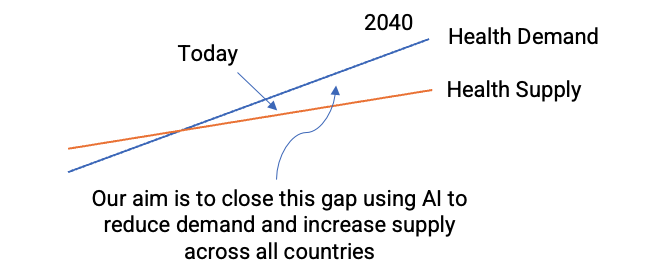
By 2040 the demand-supply gap is structural. Adding more clinicians won't close it. The only path forward is a different kind of work — one that can scale at the pace of the population.
Research and evidence
The evidence for patient activation is compelling.
ActiViseHealth is built around the evidence that patients' knowledge, skills and confidence affect service use, experience and outcomes. The Health Foundation found a strong association between patient activation and lower urgent care use.
fewer emergency admissions for patients most able to manage their conditions vs least able.
fewer emergency admissions for patients most able to manage a mental health condition alongside physical conditions.
fewer A&E attendances among most-activated patients
fewer GP appointments for the most-activated cohort
preventable admissions/year in England (best case: 333k–436k)
Source: The Health Foundation, Reducing emergency admissions: unlocking the potential of people to better manage their long-term conditions, August 2018.
What this means for ActiViseHealth
Activation cannot be treated as a leaflet or one-off conversation. It needs to be measured, personalised, supported and connected to care teams. ActiViseHealth turns this into a repeatable pathway capability by giving every patient an AI assistant that can explain, remind, coach and escalate in a way that reflects their needs and progress.
For providers who need patients supported personally.
Built for health systems, providers and care teams delivering planned operations, post-discharge recovery, long-term condition management and prevention programmes. It gives them an AI assistant that can do the high-volume, personalised support work that helps patients follow plans and helps clinicians preserve time for complex care.

For care providers
Health systems
Operationalise population health management by linking risk stratification to scalable patient activation and measurable outcomes.
Hospitals & surgical teams
Improve readiness, discharge confidence, post-operative monitoring and rehabilitation adherence on planned operation pathways.
Primary & community providers
Support patients with long-term conditions, lifestyle risks and self-care needs without relying only on manual follow-up — supported digital and human support for patients with practical, functional and social barriers.
Care coordinators
Prioritise patients who are not engaging, not ready, deteriorating or asking for help.
Patients & carers
Understand the plan, track progress, build confidence and know when to ask for help.
For the wider ecosystem
Insurers & health plans
Enabling improved medication adherence and long-term condition outcomes with subsequent reduced cost burden to the health payor — better-engaged member populations.
Pharma & Life Sciences
As part of a system to combine lifestyle changes and improve all-important adherence of therapeutics, improving efficacy of prescribed regimes with better patient outcomes. Improved engagement with and adherence to protocols also increases clinical trial data and evidence.
Employers
Enabling earlier identification and preventative care of common work-related conditions (e.g. back pain), resulting in improved productivity with reduced sickness days.
An AI company built to revolutionise health and care.
We are an AI company seeking to revolutionise the health and care industry by leveraging the power of artificial intelligence and agents. Our primary focus is to enhance and automate clinician and patient interactions and empower patients. The company is led by a senior leadership team with deep experience in each area.

Jagdip Grewal
Founder & CTO
Jagdip Grewal is the Founder and CTO. He provides strategic direction based on his 20+ years of designing health solutions at a national scale (ex NHS Chief Architect) and extensive experience in health and care systems, digital health and Data & AI.
Prior to ActiViseHealth he was an MD at Accenture in the Data & AI division, focused on health and public sector. He has an MBA from London Business School and a Computer Science degree from Cambridge University.

David Wright
CFO
David Wright, our CFO, brings pan-European finance experience in life sciences (ex CFO for a multi-country region at Amgen) and has experience in growing and funding new businesses.
He has led pan-European finance transformations and is a Fellow of the Institute of Chartered Accountants in England and Wales and holds the ICAEW Diploma in Corporate Finance. David has an MA in Mathematics and Natural Sciences from Cambridge University.

Gurpreet Singh
Chief Clinical and Commercial Officer
Gurpreet Singh, Chief Clinical and Commercial Officer, is a dynamic healthcare and healthtech executive, physician, and entrepreneur with over two decades of experience leading organisations at the intersection of clinical practice, health technology, and life sciences.
Proven track record in scaling ventures from inception to multi-million-pound revenues, shaping corporate governance frameworks, and forging high-value partnerships across health systems, payors, and top global pharma/medtech companies.
Dual board-certified surgeon and physician with an Executive MBA (Distinction), blending deep clinical expertise with commercial acumen to deliver innovative, technology-enabled models of care. Recognised advisor to start-ups, scale-ups, and accelerators, with a passion for harnessing digital health and AI to improve outcomes and extend human healthspan.

Narinder Gogna
Chief Healthcare Architect
Narinder Gogna, our Chief Healthcare Architect (ex-pharmacist), excels in product development and has 20+ years of healthcare transformation and operations, including ICS setup, re-design of hospital, community and social care services, PCN/GP setup and transformation.
Highly experienced in transformation techniques, including Lean, and in managing change holistically across process, people (roles and capabilities), technology and governance structures.
Narinder also brings his expertise from leading the design of the future NHS digital hospitals, healthcare environments, and smart buildings, and from leading the development of the business architecture of the NHS New Hospital Programme.
Start with one journey. Prove it. Scale it.
Contact us if you are interested in undertaking a pilot or just want to learn more.